From Document to Headline: Follow a News Claim’s Changing Shape
Follow a news claim from document to headline to see what each version preserves, narrows, or leaves out—and choose the right text for the question you have.
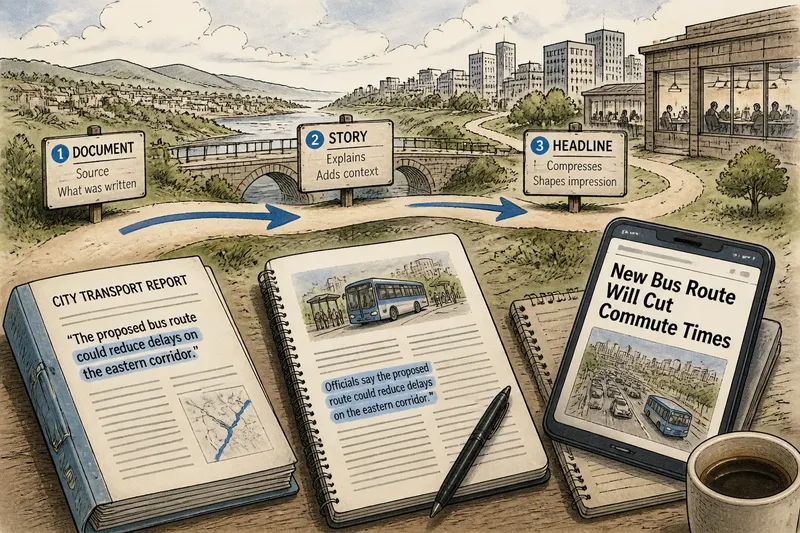
A city report says a proposed bus route “could reduce delays on the eastern corridor.” By lunchtime, a news headline reads, “New Bus Route Will Cut Commute Times.” The wording is compact, but the claim has changed: a possibility tied to one corridor now sounds like a certain benefit for commuters generally. Following a news claim from document to headline helps you see where that shift happened.
The most useful approach depends on what you want to know. You can trace the claim through each version in sequence, compare the headline with the document directly, or read the story first and use the document to check a specific point. Each has a place. The aim is not to treat every rewrite as a distortion, but to notice what each stage adds, removes, or makes sound more certain.
Three routes through a claim
Trace the chain. Start with the headline, then find the sentence in the story that supports it, then locate the relevant passage in the underlying document. This is the most revealing option when wording seems to have grown stronger along the way. It suits readers who want to understand not just what the document says, but how a newsroom turned it into a public-facing claim.
Compare two versions. Put the headline beside the document’s exact wording and ask what changed. This is quicker and often enough to assess a narrow claim, especially if the document is short or the headline makes a clear factual assertion. It suits readers checking whether the headline overstates a report, letter, court filing, or public notice.
Read the story, then verify. Read the article for context, mark the claim you care about, and check that claim against the source document. This works well when the story explains technical terms or describes events the document alone cannot convey. It suits readers who want a fuller account before examining one detail.
Think of these options like looking at a route on a map: the full route shows how you arrived, while a close-up helps answer one local question. Choose the chain when the transformation itself matters, a direct comparison when time is short, and the story-first route when context is essential.
Where wording shifts
A claim often moves through several distinct forms. The source document may state a finding, estimate, allegation, recommendation, or possibility. A reporter selects a relevant passage and explains it. An editor or headline writer compresses that explanation into a short line, where qualifiers and boundaries can disappear.
Those forms are not interchangeable. A complaint filed with a court records an allegation; it does not establish that the alleged conduct occurred. A forecast describes what may happen under stated assumptions, not necessarily what will happen. A report’s recommendation expresses what its authors favor, rather than a policy already adopted.
Watch for changes in the claim’s scope, certainty, and status. Scope concerns who or what is covered: “on the eastern corridor” may become “commuters.” Certainty concerns how firmly the statement is presented: “could reduce” may become “will cut.” Status concerns whether something is proposed, alleged, estimated, or confirmed. A headline can be accurate in one respect and misleading in another.
Also check the actor. A document may say that officials expect a change, while the headline presents the change itself as settled. “Officials say the route could ease delays” attributes a prediction; “Route will ease delays” turns it into a direct assertion. Attribution is not decoration. It tells readers whose claim they are encountering.
What each text can establish
The document can show what its author wrote and, sometimes, the basis for a conclusion. It cannot by itself show that every statement in it is correct. The article can supply reporting, responses, and explanation beyond the document. The headline can accurately summarize the article’s central point, but its compressed form may not preserve every qualification.
That distinction matters when the document is not the underlying event. A police statement, for instance, can establish what a department says happened; it is not the same as an independent account of the event. A company filing can establish what the company disclosed, not whether its interpretation is complete. Check what kind of document you have before treating its claims as settled facts.
When you find the source, confirm that it is the same document the story describes. Look for its title, issuing organization, date, and relevant section. A link may lead to a summary, an updated version, or a related attachment rather than the exact record. If a news story quotes a passage but does not link the document, search the issuing agency’s site or the public records page named in the article.
How can you check the shift?
Which words should I compare?
Compare the main verb, any modal word such as “may” or “could,” and the phrases that limit scope, time, or group. Then check whether the headline preserves the document’s attribution and whether the story explains the same claim in its body.
What if I cannot find the document?
Use the article’s description to identify the issuing organization and document title, then look for an official page or a direct link. If the source remains unavailable, treat the claim as something the article reports from that document rather than as a statement you have independently checked.
Does a changed headline mean the story is wrong?
Not automatically: headlines are shortened, and a story may supply qualifications that do not fit in the title. But if the headline makes a broader or more certain claim than the article and document support, the gap is worth noting when you share or rely on it.
A claim in practice
Say you see a headline saying, “School Plan Will Improve Reading Scores.” The story links to a district memo that says a proposed tutoring program “is expected to support reading growth,” while also noting that the plan has not been approved. The memo’s phrase describes an expectation, and the story’s approval detail establishes the plan’s status. The headline turns both into a firm outcome.
To check it, locate the memo’s exact sentence, note the word “expected,” and see what group and time period it refers to. Then read the story for the approval status and any explanation of how the expectation was formed. A more faithful headline might say, “District Proposal Aims to Support Reading Growth.” That wording preserves the proposal’s status and the goal without presenting the outcome as settled.
This invented situation shows why the chain approach helps: the relevant change is not just a stronger verb. The headline has shifted the status from proposed to definite and the result from an aim to a promised effect. A direct comparison would catch the wording, while the story-first route would help explain why the claim was made.
Choose your reading route
Use the shortest approach that answers your actual question. If you want to know whether a headline faithfully represents a source, compare the two texts. If you want to understand how an uncertain or qualified statement became a confident headline, trace the chain through the story. If you need the broader reporting context, read the story first and verify the particular claim afterward.
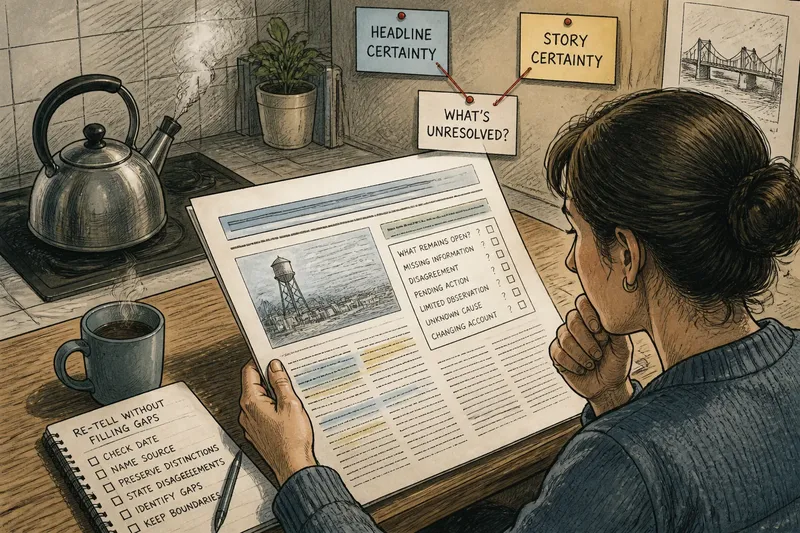
For any route, jot down the claim in plain language before judging it: who is saying what, about whom, and with what degree of certainty? That small pause separates the claim from its packaging. When you follow a news claim from document to headline, the most useful result may be a more precise account of what is known—and a clear sense of what remains only proposed, attributed, or uncertain.