One Story, Two Accounts: A Sunday Routine for Comparing News Reports
Compare two news reports by tracing their shared sources, distinct framing, and open questions, so you can describe what each account supports and leaves unresolved.
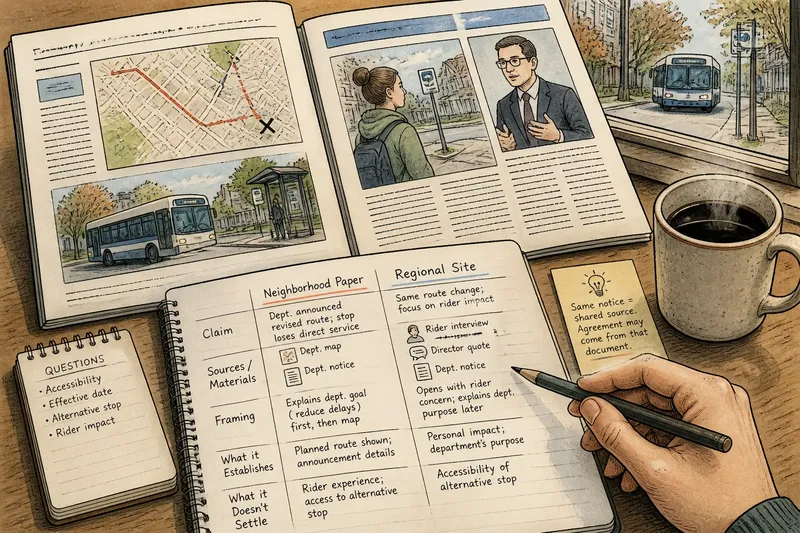
On Sunday morning, two reports about a city bus route change sit open beside a cup of coffee. One describes the transportation department’s stated goal; the other focuses on a neighborhood stop that will lose direct service. To compare two news reports fairly, look beyond their different openings and trace how each account builds its version of the same event.
The comparison below uses an invented bus-route announcement. Its purpose is not to decide which article wins, but to show how to map each report’s route through the story: what it draws on, what it brings forward, and what its chosen material cannot settle.
Match the event
Before comparing coverage, check whether both reports describe the same event at the same stage. One could cover a proposed route while another reports on a change already approved. Note the publication date, the route named, and whether the change is proposed, adopted, or in effect. A timeline difference can explain a discrepancy without either report being wrong.
On a blank sheet or in a notes app, make two columns, one for each report. Under each, jot down its date, central event, and sources or materials it names. Keep a separate margin for questions. This layout makes the articles’ different paths visible without turning the comparison into a scorecard.
Trace each report
Read both pieces once, then return to them with a pencil or a notes app. For each report, record its central claim in your own words and identify what supports it: a public notice, an interview, a map, a data document, or an explanation from an official. Distinguish what the article directly establishes from what it quotes someone as saying.
Say you are comparing two invented reports about the route change. The neighborhood paper cites a department map and a written notice; the regional site interviews a rider and quotes the transportation director. Your notes might say, “Paper: map shows planned path; notice explains announced change,” and “Site: rider describes concern; director states purpose.” Those notes describe each report’s supporting material without treating a map, a personal account, and an official explanation as interchangeable.
Also note when both articles draw on the same source. If each repeats the department’s notice, their agreement may come from that shared document, not separate confirmation. A small mark such as “same notice” beside both notes preserves that distinction.
Map the framing
Framing is the way a report organizes attention: which detail appears early, which voices receive space, and what background helps readers interpret the event. It is not automatically evidence of bias or a sign that one account is more complete.
In the invented comparison, the neighborhood paper may explain the department’s stated aim of reducing delays before describing the route map. The regional site may begin with a rider’s concern about reaching the stop and explain the department’s reasoning later. Write these as neutral observations. Then ask what each opening helps a reader understand and what context it postpones.
A route map can show a planned path but may not explain a rider’s full journey. One interview can make a local concern vivid but cannot by itself describe every rider’s experience. Think of each source as a different window in a house: it gives a useful view, but not the whole floor plan.
Build a comparison record
Use a short record that keeps the articles’ distinct contributions visible. For each entry, name the claim, the material supporting it, and the limit of what that material establishes. This prevents a shared detail from quietly becoming a broader conclusion.
- Check whether both reports identify the same route and decision stage; if they do, compare their accounts of that event, but if not, separate the proposal from the later decision.
- Check whether a date or effective date appears in each report; if both cite the same date, note the agreement and source, but if only one does, leave the other account’s timing unresolved.
- Check whether each article links its description to a map or service notice; if it does, record what that document shows, but if it does not, avoid treating the route details as documented in that report.
- Check whether both reports quote the same official statement; if they do, mark their shared source, but if they cite different explanations, record the difference rather than calling it a contradiction.
- Check whether an interview describes one person’s experience or a broader pattern; if it is one person’s account, attribute it to that rider, but if the article provides broader supporting material, note what that material covers.
- Check whether either report explains access to a replacement stop; if it does, record the explanation and who provided it, but if neither does, keep accessibility as an open question rather than assuming the stop is usable or unusable.
Where do accounts differ?
What counts as different framing?
Different framing means the reports give distinct details or perspectives different prominence. Compare their openings, source choices, and background; a difference in focus alone does not establish that their factual accounts conflict.
When is a source shared?
A source is shared when both articles rely on the same underlying material, such as one department notice or one official statement. Mark that dependence so repeated claims do not look like independent confirmation.
How should a gap be recorded?
Write the missing detail as a question and name what might answer it, such as a route notice or an accessibility explanation. Do not convert an unanswered question into a claim about what happened.
What if reports seem to disagree?
Check whether they refer to the same date, route, and decision stage, then compare the exact wording and supporting material. If the difference remains, record it plainly and leave it unresolved until an appropriate source addresses it.
Work through the notes
Imagine the two invented reports say the transportation department announced a revised route and identify the same neighborhood stop as losing direct service. The neighborhood paper cites the department’s map and notice; the regional site cites the same notice, interviews a rider who relies on the stop, and quotes the director explaining the change. Neither article says whether the alternative stop is accessible.
Your comparison record could read: “Both report the announced route change, drawing on the department notice. The neighborhood paper gives more attention to the planned path and stated purpose; the regional site gives more attention to one rider’s concern. Neither resolves accessibility of the alternative stop.” The result keeps shared sourcing, distinct framing, and an unanswered question separate. It does not claim that one account represents all riders or that the shared notice independently verifies every effect.
If accessibility would materially change your understanding, look for the department’s route notice or an accessibility statement, and check what each actually addresses. A notice may describe the planned path without explaining someone’s full journey. Comparing two news reports is most useful when your notes preserve those boundaries—and when a later update can be added without rewriting what the original articles said.