Witness, Spokesperson or Record: What a Source Can Establish
Learn what a witness, spokesperson, or documentary record can establish, so you can judge a news claim without treating one source type as decisive.

A neighbor describes a loud crash, a city spokesperson says a vehicle struck a barrier, and a maintenance log records a barrier inspection. Each source contributes something different to the same news story. To judge what a source can establish, start by asking what it had a chance to observe, record, or know—and what remains outside its reach.
Source type is not a shortcut to truth. A person who was present can misremember; an official can speak carefully while leaving out inconvenient context; a document can be authentic yet incomplete. The useful question is not “Which kind of source wins?” but “Which part of the claim does this source support, and how directly?”
Match source to claim
News claims often bundle several questions together. A report about an incident might say what happened, when it happened, who was involved, why it happened, and what authorities plan to do next. Those are distinct claims. One source may offer strong evidence about one and little about another.
A witness may be well placed to describe a sound or a visible action. That same witness may not know what caused it or what officials decided afterward. A spokesperson may be able to explain an agency’s current position but may not have been present. A record may document a date or decision while saying nothing about how an event looked to someone on the scene.
Try separating a sentence into its parts. In “A driver lost control after the warning light failed,” the claim about a warning light, the driver’s response, and the cause of the incident need not rest on the same evidence. Treating the sentence as one indivisible fact makes it easier for a source’s authority in one area to spill over into another.
Personal accounts
A witness account is a person’s description of what they perceived. Its strength depends on the particular observation: where the person was, what they could see or hear, how long they observed it, and whether distractions or obstructions mattered. “I heard a bang from the parking lot” is narrower than “A truck hit the loading dock.” The first describes a sound; the second identifies an action and its cause.
Personal accounts are especially useful for the human and sensory parts of a story: what someone noticed, how events unfolded from their vantage point, and what immediate effects they experienced. They can also help reporters identify details to check elsewhere. But a sincere account is not automatically a complete one. Memory can blur sequence, and two people nearby can honestly recall different details.
When reading an account, look for its boundaries. Does the person say what they saw firsthand, or repeat what another person told them? Is the account specific about place and timing? Does the story explain whether the person had a clear view? Careful reporting makes those distinctions visible rather than silently turning a secondhand claim into direct observation.
Official statements
A spokesperson speaks on behalf of an organization or public body. That role can make the person a useful source for the organization’s position, announced decisions, policies, or next steps. A statement may clarify what an agency says it is doing, what it acknowledges, and which questions it has not answered.
The spokesperson’s access varies. They may have information supplied by staff, a formal briefing, or an approved statement; they may not have personally observed the event. Their wording can also be shaped by the limits of what the organization is prepared to say. A statement such as “The matter is under review” establishes that the organization says a review is underway. By itself, it does not establish the review’s findings or resolve the underlying allegation.
Read official language closely. “We received a complaint” differs from “We confirmed the complaint.” “No evidence has been presented to us” differs from “The claim is false.” Those distinctions may sound small, but they mark different levels of knowledge and commitment. A careful news account should preserve them instead of translating institutional language into a stronger conclusion.
Documentary records
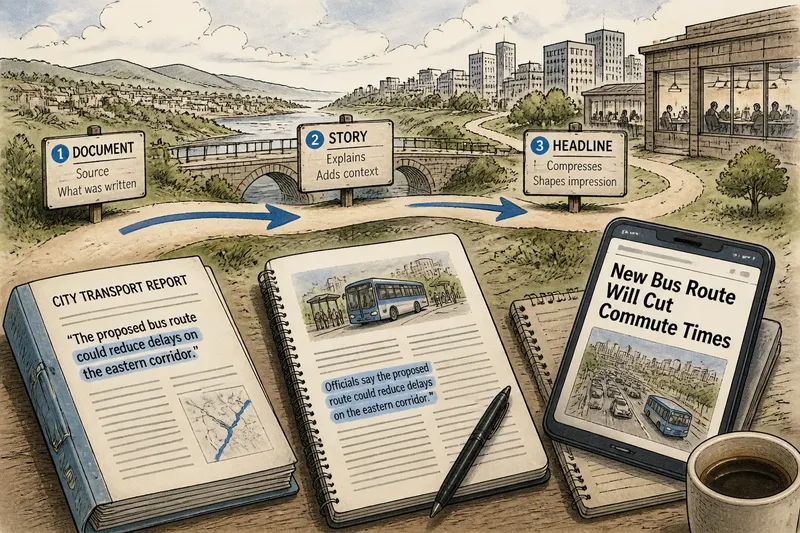
Records include items such as meeting minutes, court filings, inspection logs, emails, permits, and published rules. They can provide durable evidence of what was written, filed, scheduled, approved, or recorded. A dated agenda, for instance, can establish that a topic was listed for discussion; it does not alone establish what participants decided or whether they followed through.
A document needs interpretation as well as authentication. Who created it, for what purpose, and under what process? Is it a complete record or an excerpt? Does it show an original entry, a later correction, or a summary prepared by someone else? Even a genuine document can contain an error, reflect only one institution’s view, or omit informal events that were never recorded.
Records are particularly helpful for claims that leave a paper trail: whether a notice was issued, a vote was recorded, or a filing was submitted. They are less suited to claims about private motives, unrecorded conversations, or what a person felt. A form can show that a box was checked, not necessarily who checked it or whether the underlying condition was true.
What does each source know?
What can a witness establish?
A witness can describe what they personally perceived from a particular vantage point. Their account supports those observations most directly, while causes, motives, and unseen details may require other evidence.
What can a spokesperson establish?
A spokesperson can establish what an organization says, announces, or intends to do. The statement does not automatically establish that the organization’s account is complete or that its claims have been independently confirmed.
What can a document establish?
A document can show what its creator recorded, filed, or communicated, provided its origin and scope are clear. It cannot automatically establish that every recorded statement is accurate or that the record captures everything that happened.
Does an official record outrank a witness?
Neither source type always outranks the other; they may address different parts of the claim. A record may clarify a date while a witness describes an event that the record does not cover.
Read the gaps
A source’s silence is not always evidence that something did not happen. A record may not cover the relevant time, a spokesperson may not address a question, and a witness may not have seen what occurred beyond their view. Before drawing a conclusion from an omission, ask whether the source would be expected to include that information if it were true.
That expectation depends on purpose. Meeting minutes may summarize decisions rather than preserve every remark. A public statement may address immediate safety information but not responsibility. A witness interview may focus on what happened at a doorway, not what happened elsewhere. The shape of the source affects which absences carry meaning.
It also helps to separate “not confirmed” from “disproved.” If an official says a claim has not been verified, that describes the current state of confirmation. It does not settle whether the claim is true. If a document does not mention an event, that may reflect its scope rather than a contradiction.
Compare without flattening
When multiple source types appear in one story, compare what each contributes rather than counting them as votes. Three accounts that repeat the same original statement are not necessarily three independent confirmations. A document and a witness may seem to conflict because one records a scheduled time while the other remembers when an event actually began.
Imagine a school meeting where a parent says the doors were locked when they arrived, a district spokesperson says the building followed its access policy, and an entry log records a staff badge used at the entrance. The account describes the parent’s experience, the statement gives the district’s position, and the log records a badge entry. To assess whether visitors were admitted, a reader would need to know what the log captures, whether the parent arrived at the same entrance and time, and what the policy says. None of the three sources alone answers every part.
This is like using a map, a note, and someone’s directions: each can orient you, but each represents the place differently. The point is not to distrust every source. It is to keep the source’s scope attached to the claim it supports.
Build a careful reading
For a concrete claim, a simple source check can keep conclusions proportionate:
- Separate the claim: Break a sentence into observable actions, explanations, and predictions.
- Identify the source: Note whether the information comes from direct observation, an organization’s statement, or a record.
- Check access: Ask how the source could know this particular detail.
- Keep the wording: Preserve distinctions such as “reported,” “recorded,” “confirmed,” and “alleged.”
- Look for scope: Check what the source was created to capture and what it leaves out.
- Seek independent support: Look for evidence that does not simply repeat the same original account.
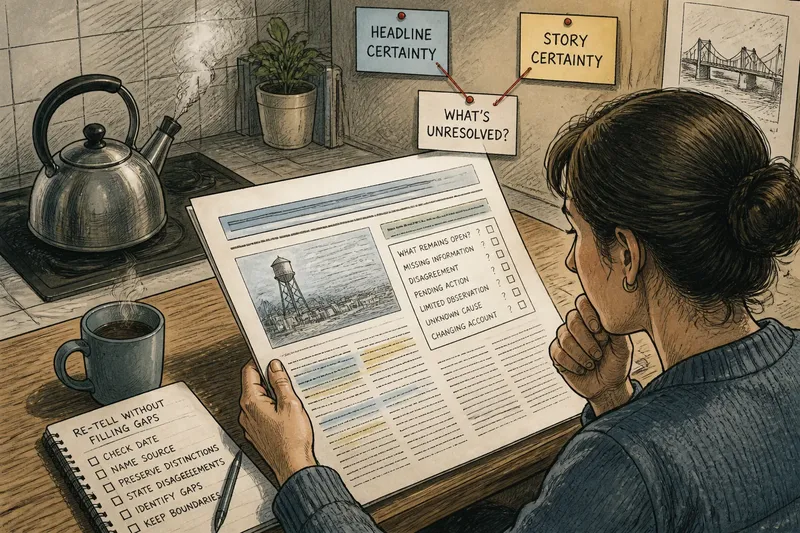
- Mark what remains open: State which parts are established, disputed, or still unclear.
For a reader, the goal is not to decide that one source category is trustworthy and another is not. It is to notice the distance between evidence and conclusion. A witness can establish a vivid observation, a spokesperson can establish an institution’s position, and a record can establish what was documented. A strong account says where those contributions meet—and where they stop.
That distinction is the heart of judging what a source can establish. When a news story attributes each detail to the source that actually supports it, you can see what is known without mistaking a partial view for the whole event.